


The existing historicist library building was designed by architect H. J. Holm and completed in 1906. The Black Diamond intentionally sets itself apart from the original building both in form and materiality. The asymmetrical versus the symmetrical, the sleek façade versus the rough brick walls. The clean lined versus the richly ornamented.
The Royal Danish Library

A Black Diamond
Located in the historic heart of Copenhagen, The Black Diamond—an extension of the Royal Library—connects some of the city's oldest and most prominent buildings to the waterfront. With its distinctive cubic form and sleek black facades, the building has become a cultural landmark. In addition to functioning as a contemporary library, it has acted as a catalyst for the revitalisation of Copenhagen’s harbour, playing a key role in weaving these cherished recreational blue spaces into the city’s fabric as we know it today.
Since its completion in 1999, the Black Diamond has become an icon for Copenhagen – a prominent, accessible, and public focal point for the life in the city, serving as an informal meeting place for citizens, students, tourists, and other guests alike. The intention for the library extension at this unique site in Copenhagen was to create a place within its context of the city. A building that would facilitate public life along the waterfront and act as a communicator between the city and the horizontal everchanging surface of the water. An architectural landmark pre-empting a new era of libraries and initiating the revitalisation of the harbour.
The design for the Black Diamond broke with the notion of the library as an outdated elitist institution by reintroducing it as more than a storage for books, marking a radical shift from traditional library structure to accommodate a wide range of cultural facilities. Its closed exterior and compact shape signal a sense of significance and solemnity, paying homage to the original library building. However, this impression finds its counterbalance in the transparent ground floor level as well as the light and organically shaped interior throughout the building.
As a relatively modest and newly established architecture studio, the accomplishment of winning 1st prize in an international competition with more than 160 contestants was a defining moment for the Schmidt Hammer Lassen’s practice. The innovative and empathetic approach to the design of the Black Diamond kindled what has since become an extensive portfolio of library designs all over the world.
Related content
The Black Diamond sits at a prime location along the Copenhagen harbour, between the two bridges of Langebro and Knippelsbro. The generative thought was to reconnect the land with the water and the city with its waterfront, which up until then had been dominated by industry and inaccessible to the public.
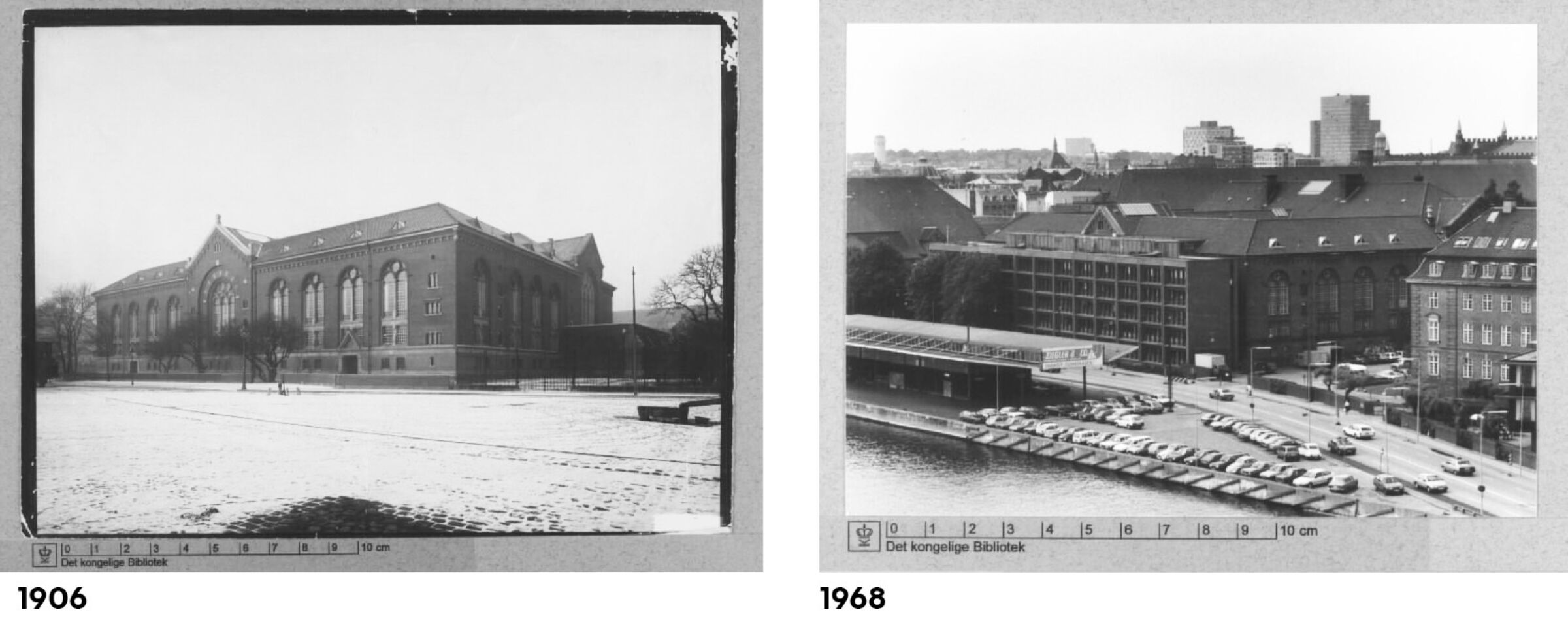
The original library building from 1906, designed by H. J. Holm in historicist style. Here seen from the waterside.


The extension of the Royal Library was conceived not simply as an addition to the existing building, but as a bold, contemporary presence in the cityscape — an embodiment of a new era, reimagining the modern library as a vibrant cultural nexus, broadening the Royal Library’s role to embrace a wider and more diverse audience — including those who come simply to enjoy the view and the proximity to the water.


One of the area’s major challenges was the busy central thoroughfare—the Ring Road—which runs along the waterfront. The design addressed this by allowing the road to pass through the building, thereby freeing the waterfront from car traffic and inviting people to enjoy the canal. The bridge links the old and new parts of the city and offers views to the north and south.
The Black Diamond was one of the first buildings to truly engage with the waterfront. Open and essentially democratic, the solid black volume is raised above the ground level to activate the surrounding public space. Since its completion in 1999, the waterfront areas along Copenhagen Harbour have undergone a significant transformation. New housing developments, cultural institutions, and public urban spaces have reshaped the harbour from an industrial zone into a vibrant and integrated part of the city — turning it into one of Copenhagen’s major attractions.

3 images
Prev
Next


Related content
- Location:
- Copenhagen, Denmark
- Programme:
- Academic Library
- Size:
- 27,000 m²
- Status:
- Completed in 1999
- Client:
- Danish Ministry of Culture
- Commission:
- 1993, 1st prize in open competition
- Interior design:
- SHL
- Engineer:
- Moe & Brødsgaard A/S
- Awards:
- 1999, The Timber Industry Information Council Award, 2000, The Architecture Prize of the Municipality of Copenhagen, 2000, Nominated for the Mies van der Rohe Award, 2001, The Nykredit Architecture Prize, 2003, Du Pont Benedictus Award
- Photo:
- Laura Stamer, Jens Markus Lindhe, Schmidt Hammer Lassen Architects
A Cultural Gem Activating the Copenhagen Waterfront
Widely known under the nickname “The Black Diamond”, the extension of The Royal Danish Library has proved its adaptability in many senses, being both a well-functioning traditional library, a meeting point for all kinds of cultural events, and standing right on the harbourfront, a significant landmark for the identity of Copenhagen and its inhabitants.
The central space, affords panoramic views over the waterfront, and also serves as a significant source of daylight which is dispersed throughout the building.
The central space affords panoramic views over the waterfront and serves as a significant source of daylight which is dispersed throughout the building.


The extension to the Royal Library is one of the most significant architectural landmarks on the Copenhagen waterfront. The solid black cube is divided in two by a vast glazed atrium, housing most of its public functions.
The Royal Library is a library for the 21st century. With large exhibition areas, a multifunctional hall for concerts and lectures, restaurant, café, library shop, four times as many reading rooms, new cultural institutes and special centres for manuscripts, book history, maps, prints, music, theatre and Oriental and Judaic literature, the new library - totalling more than 40,000 m² with room for 200,000 books on its open shelving against a capacity of previously 45,000 - stands as both a library and a wide ranged cultural and public institution.


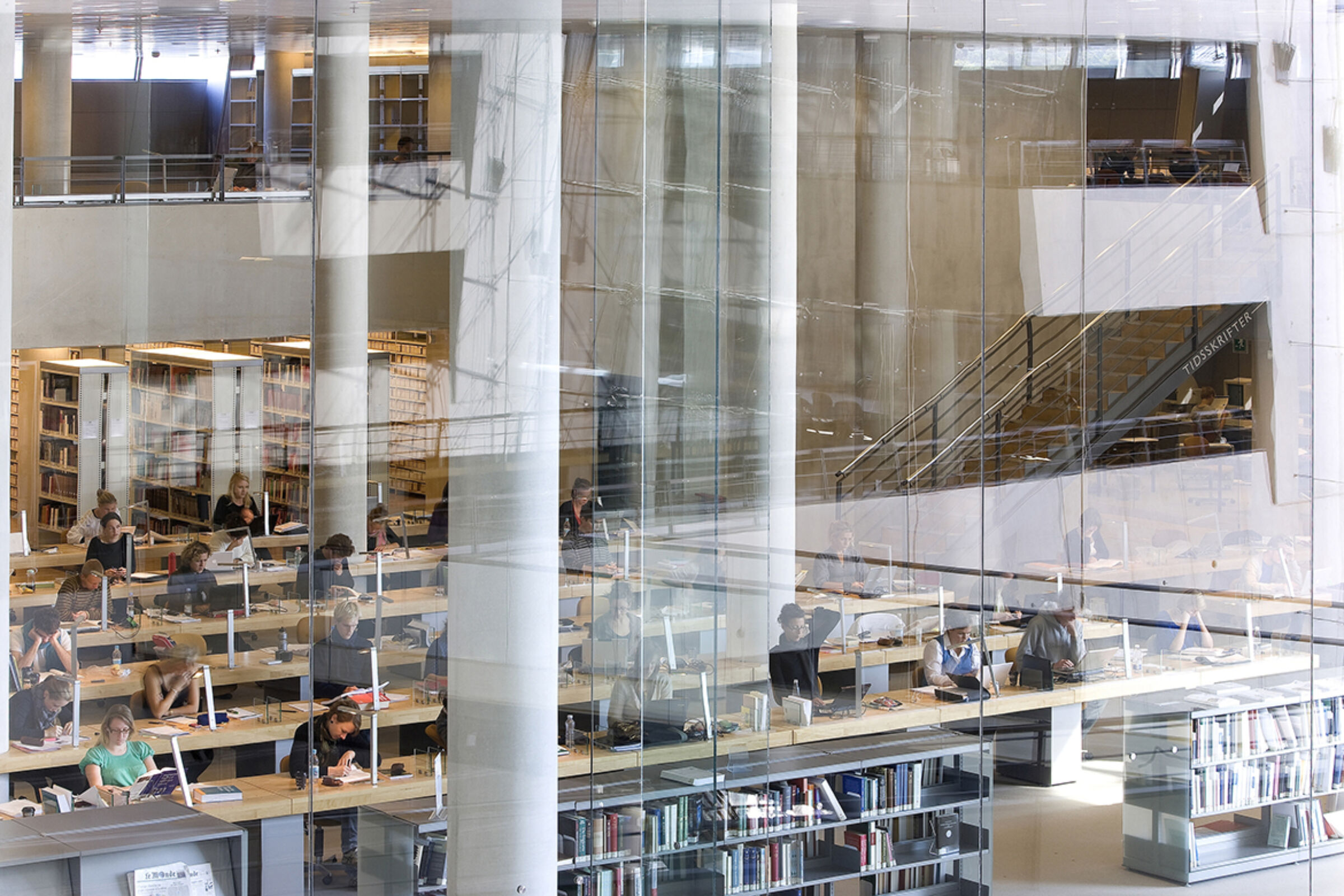
Open and essentially democratic, the building includes a café, bookshop, exhibition room, restaurant, scientific and literary institutions, as well as a roof terrace and a 600-seat hall for concerts, theatrical performances and conferences, along with six reading rooms with a total of 486 seats.


Clad in black granite, the extension to the Royal Library was soon dubbed as the ‘Black Diamond’ – with its clean-cut lines and glittering polished surfaces, the library has become a reference point of Copenhagen’s modern architecture.


Alongside acclaimed artist Per Kirkeby we identified the link area between the old library and the new building as a critical space, where an artwork could positively enhance the sense of connection that we were trying to create. Kirkeby suspended a large circular canvas floating above the information desk, a painting that announces the transition between old and new.

The Royal Library has become a contemporary icon for Copenhagen public and cultural life.
Sitting at the harbour front it embodies a prominent, yet accessible and public focal point for the life in the city and fulfils the aim of the design to create an informal meeting place for citizens in Copenhagen, students, tourists and restaurant guests.

